Laparoscopic Cystectomy in Lahore | Dr. Khadija Khan
Laparoscopic Cystectomy: A Minimally Invasive Solution for Ovarian Cysts
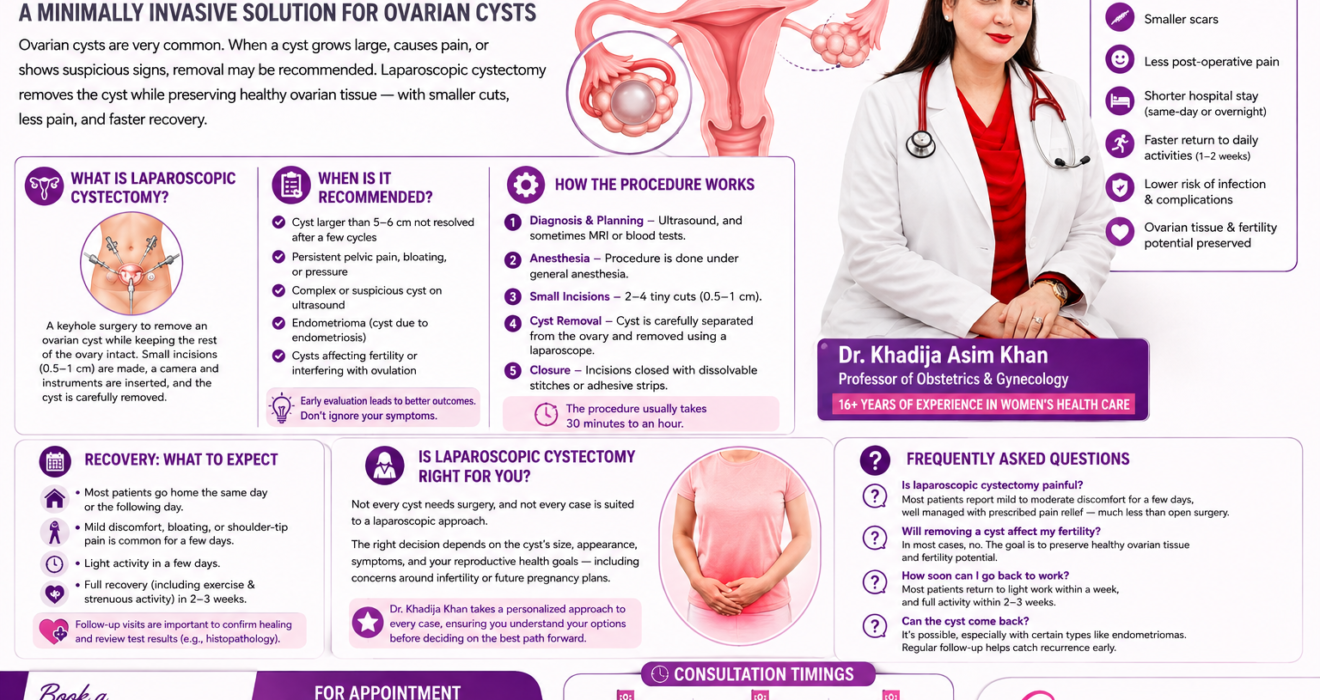
Ovarian cysts are extremely common, and most resolve on their own without any treatment. But when a cyst grows large, causes persistent pain, or shows signs that need closer evaluation, surgical removal may be recommended. For many women, laparoscopic cystectomy is the preferred approach — a minimally invasive procedure that removes the cyst while preserving the healthy ovarian tissue around it.
Dr. Khadija Khan, a Lahore-based gynecologist and obstetrician with over 16 years of experience, performs laparoscopic cystectomy for patients dealing with ovarian cysts, endometriomas, and related conditions — helping them return to normal life faster and with minimal scarring.
What Is a Laparoscopic Cystectomy?
Laparoscopic cystectomy is a keyhole surgery used to remove an ovarian cyst while leaving the rest of the ovary intact. Instead of a large abdominal incision, the surgeon makes a few small cuts (usually 0.5–1 cm) through which a thin camera (laparoscope) and specialized instruments are inserted. The cyst is carefully separated from healthy ovarian tissue and removed, often through one of the small incisions.
This approach is different from an oophorectomy, where the entire ovary is removed. Cystectomy is generally preferred when fertility preservation is a priority.
When Is It Recommended?
Your doctor may recommend a laparoscopic cystectomy if you have:
- A cyst larger than 5–6 cm that hasn’t resolved on its own after a few menstrual cycles
- Persistent pelvic pain, bloating, or pressure linked to the cyst
- A cyst with a complex or suspicious appearance on ultrasound
- An endometrioma (a cyst caused by endometriosis)
- Cysts affecting fertility or interfering with ovulation
If you’re experiencing symptoms like these, a proper evaluation is the first step — you can explore related concerns like abnormal bleeding or fibroids if your symptoms overlap.
How the Procedure Works
- Diagnosis and Planning — An ultrasound (and sometimes an MRI or blood tests) confirms the size, location, and nature of the cyst.
- Anesthesia — The procedure is done under general anesthesia.
- Small Incisions — Typically 2–4 small incisions are made in the abdomen.
- Cyst Removal — Using the laparoscope for visualization, the cyst wall is carefully separated from the ovary and removed intact wherever possible, to avoid spillage.
- Closure — Incisions are closed with dissolvable stitches or small adhesive strips.
The entire procedure usually takes 30 minutes to an hour, depending on the size and complexity of the cyst.
Benefits of the Laparoscopic Approach
- Smaller scars compared to open (abdominal) surgery
- Less post-operative pain
- Shorter hospital stay — often same-day or overnight
- Faster return to daily activities — usually within 1–2 weeks
- Lower risk of infection and complications
- Ovarian tissue and fertility potential preserved
Recovery: What to Expect
Most patients go home the same day or the following day. Mild discomfort, bloating, or shoulder-tip pain (from the gas used during surgery) is common for a few days and resolves quickly. Light activity can usually resume within a few days, while full recovery — including a return to exercise and strenuous activity — typically takes 2–3 weeks.
Follow-up visits are important to confirm healing and review any lab results (such as histopathology of the removed cyst, if applicable).
Is Laparoscopic Cystectomy Right for You?
Not every ovarian cyst needs surgery, and not every case is suited to a laparoscopic approach. The right decision depends on the cyst’s size, appearance, your symptoms, and your overall reproductive health goals — including any concerns around infertility or future pregnancy plans.
Dr. Khadija Khan takes a personalized approach to every case, ensuring patients understand their options — from watchful waiting to minimally invasive surgery — before deciding on the best path forward.
Book a Consultation
If you’ve been diagnosed with an ovarian cyst or are experiencing symptoms like pelvic pain or irregular cycles, don’t wait to get it evaluated.
Consult Dr. Khadija Khan at:
- Hameed Latif Hospital — 3:00 PM to 4:00 PM
- Iqra Medical Complex — 6:30 PM to 8:30 PM
- Khair-Un-Nisa Hospital — 9:00 PM to 10:00 PM
📞 For Appointment: 0333-4274228 🌐 www.khadijacare.com
Frequently Asked Questions
Is laparoscopic cystectomy painful? Most patients report mild to moderate discomfort for a few days, well managed with prescribed pain relief — significantly less than with open surgery.
Will removing a cyst affect my fertility? In most cases, no. The goal of a cystectomy is specifically to preserve healthy ovarian tissue and fertility potential, unlike removal of the whole ovary.
How soon can I go back to work? Most patients return to light work within a week, and to full activity within 2–3 weeks, depending on the nature of their job and recovery progress.
Can the cyst come back? It’s possible, especially with certain types of cysts like endometriomas. Regular follow-up and monitoring help catch any recurrence early.